Longest Living Sea Creatures
Longest Living Sea Creatures: The Animals and Corals That Outlive Civilizations
Before we begin, there’s one animal that deserves its own category entirely.
Turritopsis dohrnii — the immortal jellyfish — is the only known animal capable of reversing its own aging process. When stressed, injured, or starving, it can revert its cells back to an earlier developmental state and begin life again as a juvenile polyp. Scientists call this process transdifferentiation, and it gives the jellyfish a theoretically unlimited lifespan. It doesn’t age so much as reset.
It is, by any reasonable measure, the strangest exception in the animal kingdom.
But the immortal jellyfish is a biological curiosity — a single species exploiting a cellular loophole. The ocean is also home to something arguably more humbling: animals and colonial organisms that simply endure. Creatures that survive for centuries or millennia through patience, cold, stillness, and extraordinarily efficient biology. Some were alive when the first European ships reached Asia. Some were already ancient when the pyramids were built.
Here are twelve of the most remarkable long-lived animals and colonies in the sea — and what their extraordinary lifespans reveal about life itself.
1. Ancient Glass Sponges — Up to 15,000 Years
No animal on Earth lives longer than the glass sponges of Antarctica.
Anoxycalyx (Scolymastra) joubini — the volcanic sponge — has been estimated to live for up to 15,000 years, making it the longest-lived animal ever documented. Found in the frigid, stable waters of the Ross Sea, it grows at a rate of less than a centimetre per year, fuelled by one of the lowest metabolic rates in the animal kingdom. In an environment where water temperatures barely shift and food particles drift slowly through the deep, there is little biological pressure to grow fast or die young.
These sponges are filter feeders, drawing oxygen-rich water through their bodies and extracting bacteria and organic particles. Their silica-based skeleton — which gives them the “glass” name — is both incredibly delicate and surprisingly durable. A single specimen can represent a continuous biological record stretching back to the last ice age.
Cinachyra antarctica, another Antarctic species, is estimated to live in excess of 1,500 years — ancient by almost any standard, yet modest in comparison to its neighbour.
The survival of these sponges depends entirely on the stability of Antarctic ecosystems. Ocean warming, acidification, and seabed disturbance all pose direct threats to animals that have no capacity to adapt quickly. Protecting them means protecting conditions that have remained largely unchanged for thousands of years.
2. Deep-Sea Glass Sponges — Centuries in the Dark
In the deep cold waters of the Pacific — including the fjords of British Columbia and the seamounts of the North Pacific — a different family of glass sponges (Hexactinellida) forms some of the most remarkable reef structures in the ocean.
Unlike their Antarctic relatives, these sponges form interconnected reef systems — some of the only known glass sponge reefs on Earth, and ecosystems once thought to have gone extinct 40 million years ago. Individual sponges within these reefs have been estimated at up to 1,000 years old, with the reef structures themselves potentially far older.
What makes these reefs scientifically extraordinary is that they support dense communities of fish, crustaceans, and invertebrates in waters that might otherwise offer little shelter. They are habitat engineers — slow-growing, ancient, and ecologically irreplaceable.
Deep-sea glass sponge reefs have been granted protected status in Canadian waters precisely because of how catastrophically and permanently trawling damages them. One pass of a bottom trawl can destroy centuries of growth in minutes.
3. Black Corals — Over 4,000 Years
Black corals (Antipatharia) are among the most ancient and misunderstood animals on the reef. Despite the name, living black corals are rarely black — their tissue is often white, gold, or red. The “black” refers to the colour of their skeletal material, a protein-chitin structure that is incredibly slow to form and has made black coral historically prized for jewellery (a practice now regulated under CITES).
In the deep waters of the Hawaiian archipelago, black coral colonies have been radiocarbon dated at over 4,000 years old. They grow as little as 4–35 micrometres per year — a growth rate so slow it is almost impossible to conceptualise. A colony the height of a person may represent over a thousand years of uninterrupted growth.
Black corals are found throughout the tropical Indo-Pacific, including in the deeper waters of the Coral Triangle. They tend to colonise hard substrates in low-light, nutrient-rich environments — walls, overhangs, and seamounts — where they filter plankton from the passing current. On wall dives in Northwest Bali, black coral branches are a fairly regular sight on deeper sections of the reef, though most divers pass them without realising what they’re looking at.
Their longevity makes them acutely vulnerable to collection, physical disturbance, and any change in water chemistry or current patterns that disrupts their food supply.

4. Gold Coral — Around 2,700 Years
Gold coral (Gerardia sp.) is one of the rarest and most striking corals in the deep sea, and among the longest-lived animals ever precisely dated.
Colonies found in the deep waters around Hawaii have been radiocarbon dated at approximately 2,742 years — older than the Roman Empire. Like black corals, gold corals are azooxanthellate, meaning they contain no symbiotic algae and rely entirely on filter feeding rather than photosynthesis. This makes them independent of light, and able to colonise depths well beyond the reach of sunlight.
Their growth rate is extraordinarily slow — a single colony may grow only a few centimetres per century. This has made them, historically, a target for deep-sea jewellery harvesting, a practice now prohibited in most jurisdictions. Recovery from even modest disturbance is essentially impossible on human timescales.
Gold and black coral are a useful reminder that conservation timescales in the deep ocean are fundamentally different from anything we experience on land. Damage done today will not be undone in any living person’s lifetime — or their grandchildren’s.
5. Cold-Water Corals — Reef Builders in the Dark
Most people think of coral reefs as sun-drenched, shallow, tropical ecosystems. But some of the most extensive coral reef structures on Earth grow in total darkness, at depths of 200–1,000 metres, in water temperatures between 4°C and 12°C.
Cold-water corals — particularly Lophelia pertusa (recently reclassified as Desmophyllum pertusum) — build three-dimensional reef frameworks that can reach several metres in height and extend for tens of kilometres along continental margins. Carbon dating of these reef structures has produced ages of up to 8,500 years for the oldest sections, making cold-water coral reefs among the most ancient biogenic structures in the ocean.
Like their tropical counterparts, cold-water coral reefs are biodiversity hotspots — providing shelter, feeding grounds, and spawning habitat for hundreds of species of fish, crustacean, and invertebrate. Unlike their tropical counterparts, they receive no protection from photosynthesis and rely entirely on organic matter drifting down from the surface ocean.
Cold-water coral reefs are particularly vulnerable to ocean acidification. The carbonate chemistry of deep, cold water already sits close to the threshold at which coral skeletons begin to dissolve, and as CO₂ levels rise, these reefs face an existential threat within decades.
6. Massive Porites Corals — 500+ Years
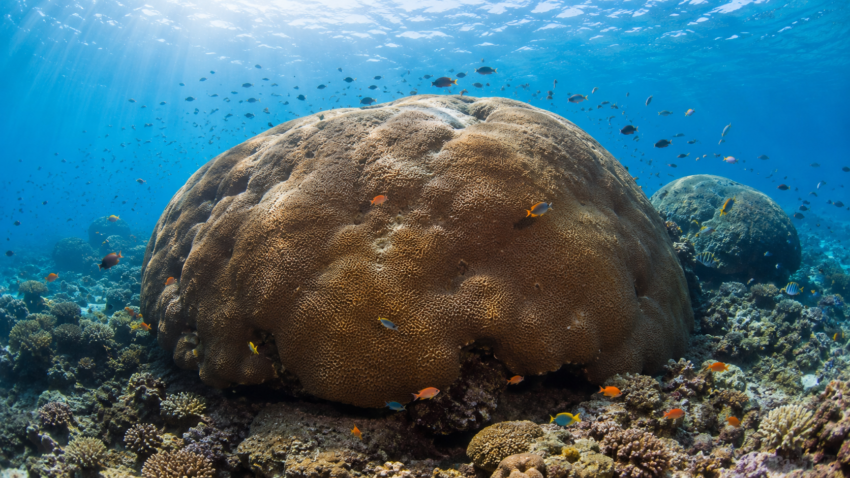
Back in the shallows, Porites corals are the workhorses of the Indo-Pacific reef. Slow-growing, dome-shaped, and almost indestructible by the standards of reef corals, large Porites heads are among the most familiar sights on any tropical dive — including right here in Northwest Bali.
What many divers don’t realise is how old those boulders actually are. Large Porites colonies have been dated at over 500 years, with growth rates of roughly 1–2 centimetres per year. A head two metres across represents something in the region of 100–200 years of continuous growth. The largest Porites colonies on record — some exceeding 5 metres in diameter — may be substantially older.
Porites corals are also valuable scientific archives. Like tree rings, their annual growth bands record water temperature, salinity, and ocean chemistry going back centuries — making them one of the primary tools scientists use to reconstruct historical ocean conditions before instrumental records exist.
On the reefs around Menjangan Island, large Porites heads are common. They are a quiet but tangible connection to centuries of reef history — and a reminder that what looks like a rock is often one of the oldest living things in the water.
7. The Ocean Quahog — 500 Years, Precisely Counted
The ocean quahog (Arctica islandica) is a clam you may have unknowingly eaten — it’s a common ingredient in clam chowder. It’s also among the most precisely aged animals on record, and the holder of a sad distinction.
Like trees, ocean quahogs form clear annual growth rings in their shells that can be counted with great accuracy. In 2006, researchers at Bangor University aged a specimen nicknamed “Ming” at 507 years — placing its birth in 1499, the year Vasco da Gama completed his first voyage to India. Ming died during the dating process.
Ocean quahogs live in the North Atlantic, buried in sandy sediment, filter-feeding on phytoplankton. Their exceptional longevity appears to be linked to unusually efficient cellular maintenance — low oxidative stress, minimal protein damage, and highly effective DNA repair systems compared to shorter-lived bivalves. They are, in effect, slow and careful machines.
Research into quahog biochemistry is genuinely informing ageing science. Understanding why their cells accumulate damage so slowly could eventually help explain — and perhaps address — aspects of human cellular ageing.
8. The Greenland Shark — Up to 500 Years
The Greenland shark (Somniosus microcephalus) is one of the most remarkable animals in the ocean — and one of the least seen. It lives in the deep, cold waters of the North Atlantic and Arctic Ocean, moving slowly through near-freezing water at depths that can exceed 2,000 metres.
In 2016, a study published in Science used radiocarbon dating of eye lens proteins — material laid down at birth and never replaced — to age a group of Greenland sharks. The oldest female in the study was estimated at 392 years, with an uncertainty range that extended to approximately 512 years. That means she may have been born before Shakespeare wrote Hamlet.
Greenland sharks grow at roughly 1 centimetre per year and are thought not to reach sexual maturity until they are around 150 years old. This makes them one of the most vulnerable large animals to overfishing — a population can be devastated long before individuals have had the chance to reproduce even a handful of times.
Their flesh contains high concentrations of trimethylamine oxide (TMAO) — a compound that acts as a cellular stabiliser against the crushing pressure of deep water, but is toxic if the meat is eaten fresh. Fermented Greenland shark (hákarl) is a traditional Icelandic food, but requires months of preparation to render it safe.
9. Orange Roughy — At Least 150 Years
The orange roughy (Hoplostethus atlanticus) is a deep-sea fish found across the world’s oceans at depths of 150–1,800 metres. For much of the 20th century it was caught and sold under the far less glamorous name “slimehead” — a rebranding exercise in the 1970s that proved remarkably effective.
Orange roughy can live for at least 150 years, possibly longer. Like many deep-sea species, they grow slowly, mature late (around 20–30 years), and produce relatively few offspring. When industrial trawling targeting orange roughy began in earnest in the 1970s and 80s — particularly around New Zealand and Australia — fisheries collapsed within years. The fish aggregating around seamounts were scooped up far faster than they could possibly reproduce.
Many orange roughy fisheries were effectively destroyed before scientists had even established the animal’s lifespan. It remains one of the clearest examples of how dangerous it is to fish a species before its biology is understood.
10. The Bowhead Whale — 200+ Years
The bowhead whale (Balaena mysticetus) is the longest-lived mammal on Earth. Individuals have been reliably documented past 200 years, with evidence including stone harpoon points found embedded in their blubber — tips matching tools from the early 1800s, meaning the whale had survived a hunting attempt and lived for another century or more afterward.
Bowheads inhabit Arctic and sub-Arctic waters, spending much of their lives beneath sea ice. They have the largest mouth of any animal, the thickest blubber (up to 50cm in some individuals), and a body plan so well adapted to extreme cold that they can break through sea ice up to 60cm thick using their massive domed skull.
What makes scientists most interested in bowheads isn’t just their lifespan — it’s their apparent resistance to the age-related diseases that afflict other large mammals. In 2015, sequencing of the bowhead genome revealed unusual variants in genes associated with DNA repair, cell cycle regulation, and cancer resistance. A whale that has been alive for 200 years and remained healthy represents an extraordinary argument that ageing is not simply inevitable — it’s a biological parameter that evolution can adjust.
11. Long-Lived Rockfish — Up to 200 Years
Pacific rockfish (genus Sebastes) are a diverse group of reef-dwelling fish found along the North American Pacific coast, and they contain some of the longest-lived fish species on the planet. Lifespans vary significantly by species, but consistently increase with depth and cold:
- Rougheye rockfish (Sebastes aleutianus): documented to at least 205 years
- Shortraker rockfish (Sebastes borealis): around 120 years
- Yelloweye rockfish (Sebastes ruberrimus): up to 150 years
Rockfish age is determined by counting growth rings in their otoliths — the small calcium carbonate structures in the inner ear, analogous to the rings in a tree or a quahog’s shell. Research has found that cold-water, deep-dwelling rockfish have significantly longer telomeres (the protective caps on DNA strands that shorten with age in most animals) than their shallow-water relatives, suggesting a direct biological mechanism for their longevity advantage.
Because rockfish mature late and reproduce slowly, they are highly vulnerable to overfishing. A 100-year-old fish removed from the population before it has reproduced extensively represents a significant biological loss — one that cannot be replaced on any human-relevant timescale.
12. Red Sea Urchin — 200+ Years of Negligible Ageing
The red sea urchin (Mesocentrotus franciscanus) is one of the longest-lived echinoderms on record, with some individuals estimated to exceed 200 years. Found along the Pacific Coast from Alaska to Baja California, these urchins are both ecologically significant and commercially harvested for their gonads — the edible roe known as uni in Japanese cuisine.
What makes their longevity biologically fascinating is that they show remarkably few signs of senescence — the gradual functional decline we associate with ageing. Older red sea urchins continue to move, feed, and reproduce at rates comparable to much younger individuals. They grow continuously throughout their lives, meaning a larger specimen is almost certainly an older one.
This pattern — where an organism ages in calendar time but not in biological function — is described by gerontologists as negligible senescence, a term coined by researcher Caleb Finch. A small number of marine animals, including the red sea urchin, the ocean quahog, and the bowhead whale, exhibit versions of this trait. Understanding the cellular mechanisms behind it is an active area of research with significant implications for human medicine.
Diving Into Living History in Northwest Bali
You don’t need to reach the deep ocean to encounter animals and colonies that predate you by centuries.
On the reefs around Menjangan Island — protected within Bali Barat National Park — large Porites coral heads represent decades to centuries of continuous growth. Black coral branches trail from the walls on deeper dives. The reef ecosystem itself, shaped by slow biological processes over vast time, is a living record of conditions stretching back long before any of us arrived.
Understanding what you’re looking at changes the experience of a dive. A boulder coral isn’t just scenery — it may be several hundred years old. A black coral branch reached that size over timescales that make a human lifespan look brief.
If you’d like to explore Northwest Bali’s reefs with guides who genuinely care about what lives there — and why — take a look at our Menjangan Island diving and Pemuteran reef dive pages. Our conservation work in Pemuteran is also ongoing, and divers are always welcome to learn more about what we’re working to protect.
At Abyss Ocean World, we think the ocean is most worth visiting when you understand what you’re swimming through. Our dive guides are marine educators as much as they are instructors — and the reef always has more to tell than any briefing can cover.

